
Key Takeaways:
-
States are investing in Talent Marketplaces to better connect education and workforce pathways, but they need both Ed-Fi and 1EdTech standards to ensure learner data, credentials, and opportunities can move reliably across systems over time.
-
The Ed-Fi Data Standard verifies and manages what happens inside education systems, while 1EdTech standards like LTI, CASE, Open Badges, and CLR make credentials and skills visible, portable, and trustworthy beyond those systems.
-
Using Ed-Fi and 1EdTech together enables states to build scalable, vendor-neutral Talent Marketplaces that reduce risk, protect learners, and create lasting public infrastructure connecting learning to workforce opportunity.
For more than a decade, we’ve talked about connecting education to opportunity. We’ve launched platforms, built dashboards, issued credentials, and promised “skills-based hiring.” And yet, for many learners, especially those navigating non-traditional pathways, the system still feels fragmented, opaque, and hard to trust.
What’s missing isn’t effort.
What’s missing is interoperability by design.
As states invest in Talent Marketplaces—whether through the Connecting Talent to Opportunity Challenge or broader workforce initiatives—we have an opportunity to get the architecture right. Not just for a single program or vendor, but for an ecosystem that can evolve over time.
That requires thinking clearly about which standards do what, and how they work together.
Two Kinds of Interoperability We Often Confuse
One of the most common mistakes I see is treating all standards as interchangeable. They’re not.
There are really two different interoperability problems states are trying to solve:
- Operational data interoperability
How do we reliably manage student, course, and program data at scale? - Ecosystem interoperability
How do learners, credentials, skills, and opportunities move across platforms, sectors, and time?
Both matter. They just live at different layers.
Where Ed-Fi Fits: The System-of-Record Foundation
For many states, Ed-Fi is already doing the heavy lifting for K–12.
The Ed-Fi Data Standard provides:
- A stable, well-governed model for students, enrollments, courses, assessments, and programs
- APIs that power state longitudinal data systems
- A shared operational backbone across districts and vendors
In a Talent Marketplace context, Ed-Fi plays a critical role:
- Verifying participation and completion
- Supporting eligibility and reporting
- Providing trusted inputs into downstream systems
Ed-Fi answers the question:
“What actually happened in the education system?”
That’s essential — but it’s not sufficient on its own.
Where 1EdTech Standards Fit: The Bridges Between Systems
Once learning extends beyond a single system—into credentials, skills frameworks, learner records, and employer platforms—we need a different set of standards.
This is where 1EdTech interoperability standards come in.
Each one addresses a specific, practical need:
- Learning Tools Interoperability (LTI)® – Secure, context-aware access from LMSs and training platforms
- OneRoster® / Edu-API™ – Identity, roles, enrollment, and participation across systems
- Competencies and Academic Standards Exchange® (CASE®) – A common, machine-readable language for skills and competencies
- Open Badges – Verifiable, portable digital credentials
- Comprehensive Learner Record Standard™ (CLR Standard®)– A package of of multiple, related achievements, including Open Badges
Together, these standards answer a different question:
“How does learning become visible, portable, and usable beyond the system where it occurred?”
Why States Need Both
This isn’t an “either/or” decision.
Ed-Fi provides the foundation.
1EdTech standards provide the bridges.
When used together, states can:
- Leverage existing K–12 investments
- Avoid rebuilding system-of-record infrastructure
- Enable credentials and skills to move into workforce ecosystems
- Support AI-enabled matching without sacrificing trust or governance
- Give learners control over how their achievements are shared
Most importantly, this approach reduces risk:
- Less vendor lock-in
- Fewer one-off integrations
- Clear accountability through standards certification
What a Standards-Based Talent Marketplace Looks Like
Below is a simple, one-slide view of the architecture that brings these pieces together.
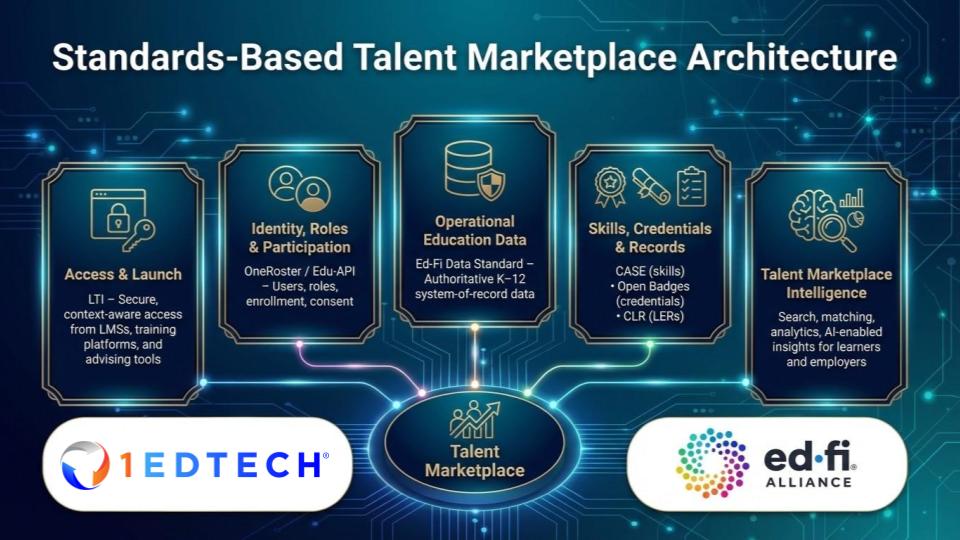
At a glance:
- Learners access the marketplace through the tools and platforms they already use with LTI integrations.
- OneRoster or Edu-API exchange Identity, enrollment, and participation data securely and consistently across systems
- K–12 operational and learner data flows from Ed-Fi–enabled systems into connected workforce and postsecondary environments
- CASE inventories provide the common framework layer, aligning academic standards, competencies, skills, and achievement frameworks so learning and workforce data can be understood consistently across institutions and states
- Ed-Fi, CASE, Open Badges and other inputs are captured through the Comprehensive Learner Record Standard to inform Learning and Employment Records (LERS) or showcase pathway progress
- Employers and agencies can consume trusted, machine-readable credentials and skills data to support hiring, advising, and cross-sector accountability
This architecture is not about any single program or challenge.
It’s about building public infrastructure for learning and work.
A Final Thought for State Leaders
Talent Marketplaces aren’t just technology projects.
They are governance decisions.
The choice to require open, certified standards is a choice to:
- Protect learners
- Preserve flexibility
- Enable innovation without fragmentation
- Build systems that last longer than any single vendor or grant
If we want talent marketplaces to be more than portals—and more than pilots—we need to build them as a public utility: designed to serve everyone reliably, consistently, and over the long term.
That starts with getting the standards right.
Additional Resources:
Sample RFP Language for CTO Challenge
CTO Challenge Scoring Criteria Mapping
Building Interoperable Talent Marketplaces Presentation
About the Author
As the Vice President of K12 Programs at 1EdTech, Dr. Tim Clark assists schools and districts in the adoption of 1EdTech standards and practices to enable interoperable and secure digital learning ecosystems. He also provides strategic leadership for K12 in 1EdTech in collaboration with K-12 institutional and state department of education members of the consortium.
Tim holds a Doctor of Education in Leadership for Learning with a concentration in Instructional Technology, and his research and dissertation focused on designing online learning communities for elementary students. Throughout his career, he has been a vocal advocate for the implementation of instructional technology, digital content, and curriculum in order to increase achievement and motivation, to encourage collaboration, to facilitate critical thinking, and to construct engaging learning environments.