Key Takeaways:
-
At 1EdTech’s 2026 Technical Congress, members explored how existing standards could work together to provide AI with trusted, task-specific learning context while protecting learner data.
-
Updating security and identity frameworks can help systems manage access and share consistent learner information as connections grow.
-
Proposed governance changes aim to speed compatible updates while preserving member review and the safeguards that make standards trustworthy.
I've been in education technology long enough to know the hardest part of a standard is never writing it down. It's keeping it honest and relevant as the world around it changes. And right now, the world is changing fast.
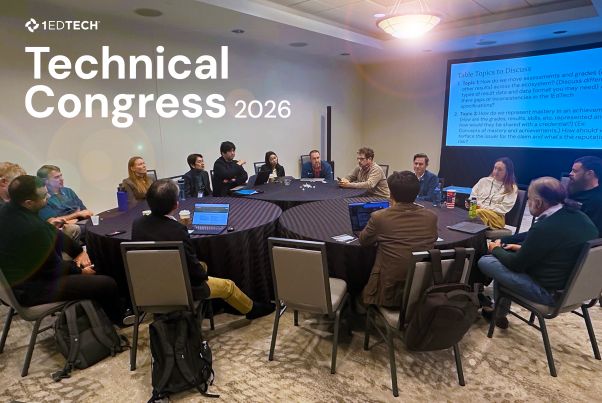
That's what made this year's Technical Congress feel different to me. Nobody in the room was debating whether AI, security, and global adoption would reshape our work. We all know they will. The real conversation was about how we, as a community, make our standards work together and evolve quickly enough to matter. Here's what stuck with me.
Trusted portable learning context: from good ideas to something you can build
Over the past year, our community has developed six proposed principles for trusted, portable learning context. The goal is simple to say and hard to do: give AI enough of the right information to genuinely help with a learning task, while protecting the learner and keeping institutions in control of their own data.
Principles are a good start. And a principle nobody can implement is just a nice sentence. So at the Tech Congress, members rolled up their sleeves and asked how the standards we already have, ours and those from partners across the ecosystem, could carry those principles into real systems.
One example I keep coming back to: a verified credential with pre-approved context that can answer an AI agent's question about a learner and a specific task. Not everything about the learner. Just what's needed, from a source you can verify. Members also worked through how to request information, confirm where it came from, connect related learning records, and describe learning activity consistently.
I want to be clear that none of this is proven yet. Next, we'll look at how these standards fit together, find the gaps, and put the principles to the test at Learning Impact and other events in 2027.
Security and identity: two sides of the same coin
As more systems connect and AI moves into everyday workflows, a breach in one place doesn't stay in one place. I won't pretend standards can stop every cyberattack. They can't. Good standards can limit how far an attack spreads, however, and that matters enormously.
Members discussed reviewing our Security Framework against evolving industry practice and AI, including better ways to protect digital access passes and clearer rules for what people and applications are allowed to reach.
Identity is the other side of that coin. Today, a learner might be an email address in one system, a decentralized identifier (DID) in another, and an institution-assigned ID in a third. Fields with the same name sometimes carry different information. A credential may need learner details an LTI-connected tool never sees. That's the kind of quiet inconsistency that causes real problems at scale.
The path forward is updated identity frameworks that spell out which identifiers fit which uses, applied consistently across 1EdTech standards. If this is your world, I'd encourage Contributing Members to join the Security Committee, and watch for more ways to get involved in 2027.
Governance that moves at the speed of the work
Here's a less glamorous truth: you can't do serious cross-specification work with a process built for a slower era. Members talked about regional profiles that live inside our core specifications, a lighter review path for smaller compatible updates, and full review reserved for changes to a specification's core.
What excites me is that these proposals give members a bigger voice in governance without trading away the safeguards that make 1EdTech standards worth trusting. Speed and quality don't have to be at odds. Draft policies are coming for member review in the next few months. Please read them closely and tell us what you think.
Together is the new standard
If the Technical Congress reinforced one thing for me, it's that standards work can't happen in silos, whether between specifications, organizations, or regions. When members and partners come together to do the hard work, our standards can keep pace with technology and continue serving the people who matter most: learners, educators, and the institutions that support them.
One conversation in particular emphasizes this point: a provider member attending a 1EdTech working session for the first time, was thrilled to be deliberating with competitors and institutions representative of their customer base. He recognized the value in working together and promised to stay deeply invested and involved in the work going forward
Thank you to everyone who came, debated, sketched on whiteboards, and pushed us forward. Together really is the new standard.
About the Author
1EdTech CEO Curtiss Barnes has over 30 years of experience in the education industry and expertise in a broad range of enterprise and instructional systems supporting education's core missions. He has held roles at universities, technology start-ups, large enterprise businesses, and courseware and publishing companies.
Curtiss holds an MBA from the Wharton School of the University of Pennsylvania and a bachelor’s degree in economics from Clark University.